
High load hosting is a type of hosting designed to ensure high performance and uncompromising reliability for websites under heavy load. This load can come from a large number of users or processed requests, or from a large volume of processed data.
The Shop'n'SEO platform's server software can handle up to ten times the load of standard projects on servers with the same configuration and default settings. We offer specialized performance-optimization tools and network solutions that ensure instant site response even under heavy load.
High load hosting is especially useful for large online stores, social networks, news portals, and other high-traffic sites. It ensures stable operation and fast page-load speed, which is a key factor for SEO optimization. It's no secret that search engines favor sites with minimal response time in organic search results. Google's and Yandex's requirements are fairly simple – no more than one second to load a page. A load time over two seconds is considered slow. Loading a page in the browser should not be confused with the moment the page is actually «rendered» by the browser.
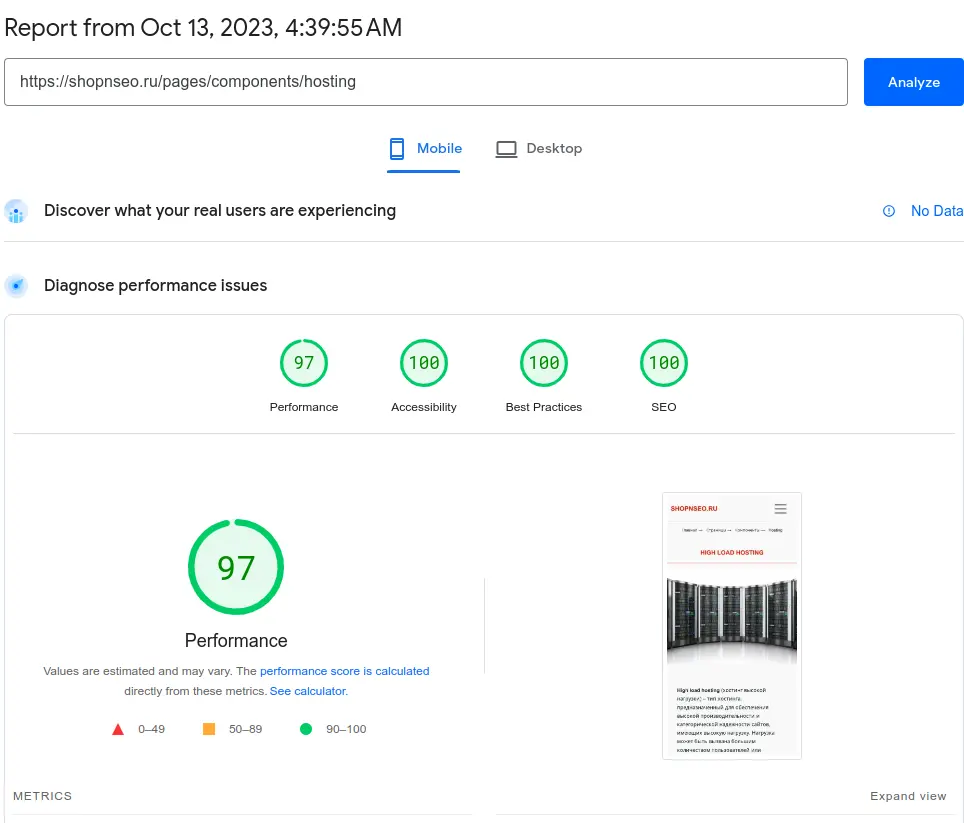
Given this paradigm, the goal of the High load hosting software component is to achieve the best possible result for page load and render time. There are many metrics that assess rendering speed. Our primary benchmark is Speed Index, which should be under two seconds. For this specific page, the Speed Index is 0.9 sec. Refresh the page! If you're happy with the result – now's the time to consider ordering the High load hosting component!
We'd also like to flag the component's one drawback, noticeable to every user – the absence of a graphical control panel. Setup, debugging, and other operations are performed via the server console. This single drawback defines the component's main advantage: its simplicity and speed, since there are no extra layers on top of the server. The SnS control panel and the semantic-core assembly component are built directly into the server, bypassing third-party mediators.